


Air Cooler vs Air Conditioner: Which One Should You Choose?
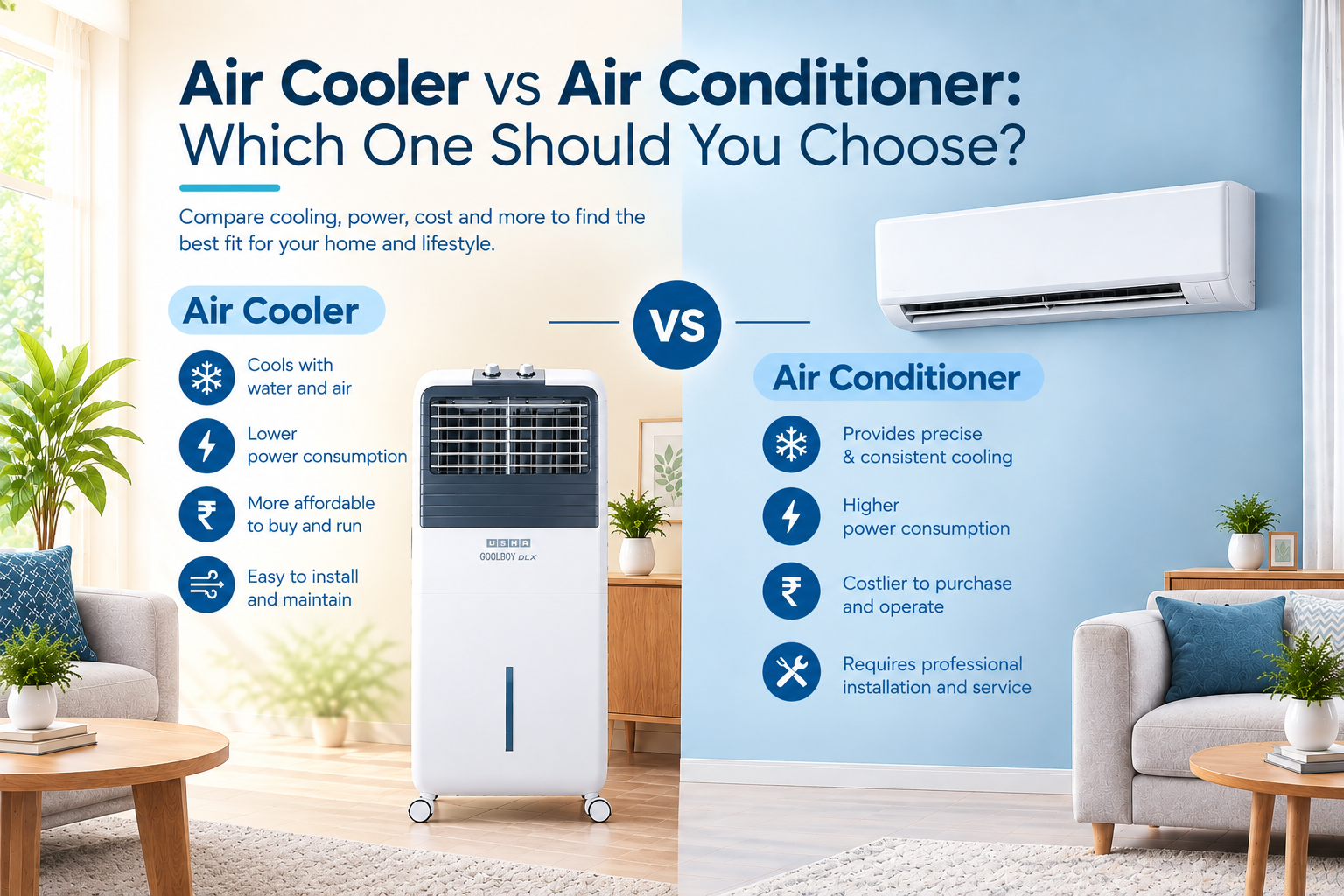
As temperatures and humidity levels rise, many of us wonder whether an air cooler or air conditioner is the better choice for beating the heat. While both appliances cool a room, they differ in installation, maintenance, energy consumption, and ideal operating conditions.
For instance, air coolers can be a good choice if you want an appliance with low power consumption and simple installation and maintenance requirements. Usha offers a range of efficient air coolers to suit different needs.
But if you are unsure whether to choose an air cooler or an air conditioner, refer to this guide for more clarity.
Air Cooler vs AC: Side-by-Side Comparison Table
| Parameter | Air Cooler | Air Conditioner |
|---|---|---|
| Electricity Consumed | Low | High |
| Cooling Comfort | Low to Medium (depends on model) | Medium to High (depends on model) |
| Environmental Benefits | Do not emit harmful gases like CFCs | Emits harmful gases like CFCs |
| Maintenance Requirement | Low; Need to add water daily | As per owner's manual |
| Maintenance Cost | Low | High |
| Installation | No Need; Simply place in desired position | Required |
How Air Coolers and Air Conditioners Actually Work
While both air coolers and air conditioners cool a room, they do so differently. Discover more about this below.
How an Air Cooler Works?
An air cooler works through evaporative cooling. It draws warm air from the room through water-soaked cooling pads. As the water evaporates, it absorbs heat from the air, lowering its temperature. The cooler then circulates this cooler air back into the room, helping reduce the overall room temperature.
Usha Air Coolers feature an EcoCool Honeycomb Technology, designed to retain enough water for an enhanced cooling experience and provide a consistent supply of cool air for a longer period.
How an Air Conditioner Works
An air conditioner, on the other hand, uses several components to cool a room. It absorbs warm air through the return vents, which then passes over a cold evaporator coil. The refrigerant flowing through the evaporator coil absorbs heat from the warm air.
Next, the compressor compresses and pressurises the refrigerant, increasing its temperature. The hot refrigerant then moves to the condenser coil, where it releases the absorbed heat to the outside air.
The refrigerant then changes from a gas to a liquid as it releases heat. It passes through the expansion valve, where its pressure and temperature drop. The cool refrigerant then flows back into the evaporator coil, where it absorbs heat from the indoor air, and the cycle repeats.
Air Cooler vs Air Conditioner Electricity Consumption
Air coolers generally cost less to run than air conditioners because they have lower power ratings and consume less electricity. Take a look at the sample table below.
| Air Cooler/ Air Conditioner Type | Units Consumed (Monthly) | Electricity Cost (Monthly) |
|---|---|---|
| Personal cooler | 24-36 units | Rs 168 - Rs 252 |
| Desert/Tower cooler | 36-72 units | Rs 252 - Rs 504 |
| 1.5 Ton air conditioner with a 5-star inverter | 168-240 units | Rs 1,176 to Rs 1,680 |
| 1.5 Ton air conditioner with a 3-star non-inverter | 288-432 units | Rs 2,016 to Rs 3,024 |
Note: The costs have been calculated by assuming a 7 rupee/unit cost and a daily usage of 8 hours, which is an approximate average across Indian states.
Usha Air Coolers, for example, have power ratings ranging from 100W to 500W, which are generally lower than the power consumption of 1.5-ton air conditioners. Depending on the model and star rating, a 1.5-ton AC may typically consume around 1,000W to 1,800W during cooling.
So, they consume less electricity than air conditioners, which leads to increased savings. However, keep in mind that your actual electricity costs will depend on how long you use them.
Air Cooler or Air Conditioner - Which is Best for Health?
Both air coolers and air conditioners have distinct advantages related to your health, while air coolers are relatively better than air conditioners. Take a look at the table below for a better understanding.
| Parameter | Air Cooler | Effect on Health | Air Conditioner | Effect on Health |
|---|---|---|---|---|
| Air Circulation | Draws in and circulates outside air | Can improve ventilation when used with adequate airflow | Primarily recirculates indoor air | Proper ventilation and filter maintenance are important for indoor air quality |
| Humidity | Increases indoor humidity | More comfortable in dry conditions; excessive humidity may encourage mould and microbial growth | Typically reduces indoor humidity | Can improve comfort in humid conditions; very dry settings may cause skin or throat discomfort |
| Breathing Comfort | Can feel more comfortable in dry climates | May help relieve discomfort caused by dry air | Cools and dehumidifies indoor air | Comfortable when set to a moderate temperature; very low temperatures may cause discomfort |
Usha’s air coolers have an EcoCool honeycomb cooling pad that ensures a supply of fresh, moisturised, cool air, which may help improve respiratory health.
Which Climate Suits Air Coolers vs Air Conditioners: Dry Heat vs Humidity
Air coolers are more suited to cities or regions with drier climates or seasons. Usha air coolers, are designed to work in regions with humidity of up to 60% or less.
On the other hand, air conditioners are more suited to places with humid weather.
Installation, Maintenance & Upfront Cost
Air coolers don’t require any complex installation. All you need to do is place them in the desired spot and connect them to the power socket.
Similarly, they have relatively low maintenance requirements, mainly refilling water daily, and their upfront costs are low.
Usha Air Coolers, like the AZZURO DLX 50L Window Air Cooler, for example, feature space-saving, window-AC-style design for easy installation.
On the other hand, air conditioners require wall-mount installation with an outdoor unit. Moreover, they incur high maintenance costs due to their various components, while their upfront installation cost is higher than that of air coolers.
Explore USHA Air Coolers by Type
| Usha Air Cooler Type | Air Delivery Rate (can vary by model) | Features |
|---|---|---|
| USHA Desert Air Coolers | 6500 m³/hr | Heavy-duty castor wheels for easy movement, efficient cooling and long life |
| USHA Window Air Coolers | 3200 m³/hr | Compact design, Thermal overload protection technology |
| USHA Tower Air Coolers | 2000 m³/hr | Rust-free fan blade, Ultra-durable pump |
| USHA Personal Air Coolers | 1100 m³/hr | Large fan, High tank capacity |
Unable to decide which one you want? Use the USHA Air Cooler Size Calculator to choose the right air cooler for yourself.
Wrapping Up: Air Cooler or Air Conditioner Which is Best
When deciding between an air cooler vs AC, you need to consider your unique requirements. Air conditioners have higher maintenance, installation, and operating costs and are best suited for humid climates.
Air coolers suit dry climates and have lower maintenance, installation and operating costs. Usha’s range of air coolers, on the other hand, is equipped to provide rapid cooling in dry and humid conditions, up to 60% and is easy to install.
Explore more on the website or Find a USHA Dealer for more details.
Frequently Asked Questions
Q.1 Is an air cooler cheaper to run than an AC?
Ans: Yes, an air cooler is cheaper to run than an AC because of its relatively low power rating.
Usha Air Coolers feature optimal power ratings, which can help you save on your electricity bill. However, do keep in mind that your total electricity bill consumption will depend on how much you use the appliance.
Q.2 Is an air cooler healthier than an AC?
Ans: An air cooler may improve your health in dry conditions because of its cooling method.
Usha’s air coolers feature the EcoCool honeycomb cooling pad, which ensures a supply of fresh, moisturised and cool air that may improve your respiratory health.
Q.3 Can an air cooler work as well as an AC in humid weather?
Ans: Usha Air Coolers are designed to work optimally in areas with humidity of up to 60%. They also feature powerful fans and EcoCool Honeycomb cooling pads for a consistent supply of fresh, moisturised cool air.
Q.4 Which is better for a bedroom - air cooler or AC?
Ans: Usha’s air coolers, like window air coolers, are ideal for bedrooms because their space-saving, window-AC-style design makes installation easy and delivers rapid, efficient cooling.
Q.5 Which is better overall - air cooler or AC?
The answer depends on your cooling needs and climate. Air coolers are generally energy-efficient and cost-effective cooling options, especially in dry and hot conditions. On the other hand, ACs are suitable for consistent cooling and dehumidifying spaces in hot, humid weather conditions. If you are looking for efficient cooling with lower power consumption, a Usha Air Cooler can be a practical choice.